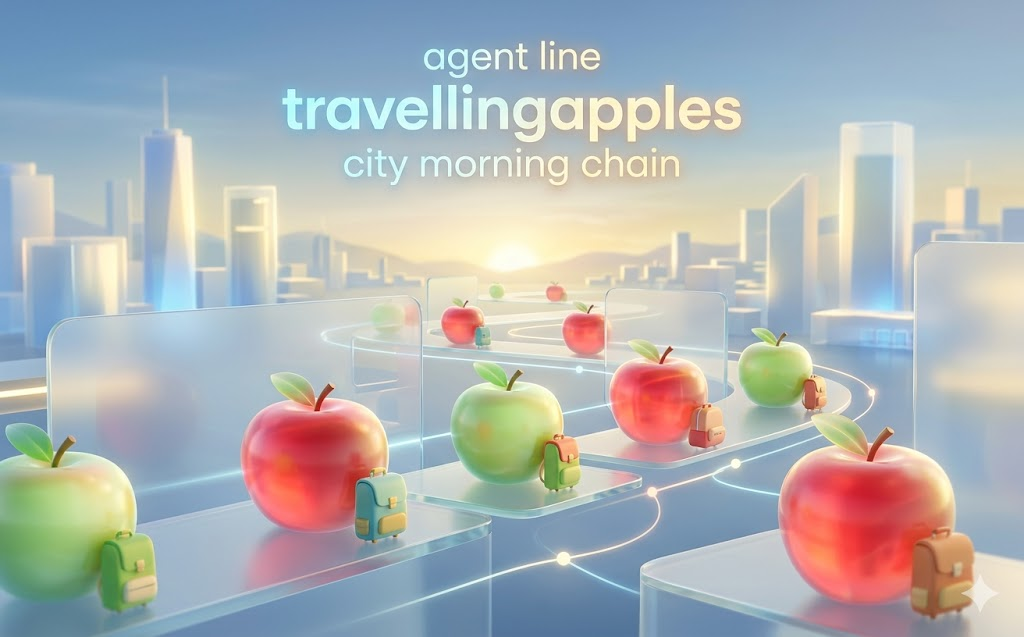

Every great city has a secret. It runs quietly, invisibly, and almost entirely before most residents open their eyes. By the time commuters crowd the metro platforms and café owners flip their open signs, an entire economy has already completed its first full cycle of the day. Trucks have rolled, vendors have unpacked, routes have been cleared, and markets have come alive. This is the world of the agent line travellingapples city morning chain — a framework for understanding how cities breathe, feed themselves, and connect people through coordinated movement in the earliest hours of the morning.
This is not a minor logistical footnote. Morning urban chains represent billions of dollars in commerce, millions of daily livelihoods, and the invisible architecture that holds modern city life together. Yet most people who benefit from these systems never think about them. They simply find fresh bread at the bakery, vegetables stacked neatly at the market, and buses arriving on schedule. What they do not see is the extraordinary coordination required to make all of that happen.
Understanding the agent line travellingapples city morning chain means understanding the soul of a city — not just its skyline or its famous landmarks, but its rhythms, its workers, and the invisible threads that bind neighborhood to neighborhood before the sun clears the horizon.
What Is a City Morning Chain? A Working Definition
Before diving deeper, it helps to define terms clearly — something competing articles on this subject almost entirely fail to do.
A city morning chain is a coordinated sequence of logistical, commercial, and human mobility events that occur during pre-peak hours, typically between 2 AM and 8 AM, that collectively enable a city’s daytime economy to function. It involves multiple actors — suppliers, transport agents, market vendors, infrastructure operators, and early commuters — each playing a distinct role in a tightly sequenced chain of activity.
The “agent line” component refers to the network of intermediaries and operators who physically move goods and people along defined routes. These agents include delivery drivers, logistics coordinators, public transport operators, and market middlemen. They are the connective tissue of the urban morning.
Within the agent line travellingapples city morning chain model, three core pillars support the entire structure:
Movement: People and goods must travel from point A to point B reliably and on schedule.
Timing: Everything depends on sequencing. A delivery arriving 90 minutes late does not just inconvenience one vendor — it can cascade into shortages, lost sales, and disrupted downstream schedules.
Coordination: No single actor operates in isolation. The truck driver depends on the warehouse operator. The vendor depends on the truck driver. The consumer depends on the vendor. Each link reinforces the next.
This framework, which sits at the heart of the agent line travellingapples city morning chain concept, is not abstract theory. It plays out every morning in thousands of cities across the world, from megacities of 20 million people to regional market towns of 200,000.

The Key Players: Who Makes the Morning Chain Move
The morning chain is populated by people who rarely receive public recognition. Understanding who they are — and what they do — is essential to appreciating the system as a whole.
Wholesale Suppliers and Producers are the chain’s origin point. Farmers, food processors, manufacturers, and importers begin loading shipments in the middle of the night. Their goal is to get products into the city before peak-hour traffic makes movement inefficient and expensive.
Logistics Agents and Freight Coordinators manage the movement of goods from distribution hubs into neighborhood markets. These are the true “agents” in the agent line travellingapples city morning chain framework. They optimize routes, manage multiple vendors simultaneously, and respond in real time to road conditions, weather disruptions, and demand fluctuations. Modern logistics agents use route optimization software such as OptimoRoute, Circuit, and Onfleet — tools that have dramatically reduced delivery times and fuel consumption in cities that have adopted them.
Market Vendors and Small Business Operators are the chain’s commercial face. Street vendors, independent grocers, restaurant owners, and bakery operators depend entirely on morning deliveries to prepare their businesses for the day. In cities like Istanbul, vendors at the Grand Bazaar begin receiving goods as early as 4 AM. In Mumbai, the famous dabbawalas — a legendary lunch delivery network — begins its morning preparation sequence before dawn, eventually achieving a delivery accuracy rate that Harvard Business School researchers once estimated at 99.99%.
Public Transport Operators run the parallel human mobility chain. Bus drivers, metro system operators, and rail crews begin their shifts in the pre-dawn hours, positioning vehicles and running safety checks so that commuter services are ready when demand spikes. This human chain is inseparable from the goods chain — both require the same road infrastructure, and coordination between them determines whether morning city movement is smooth or chaotic.
Urban Planners and Traffic Management Teams operate behind the scenes but shape everything. Their decisions about bus lane placement, delivery window regulations, traffic signal timing, and zoning determine how effectively the agent line travellingapples city morning chain can function in any given city.
Three Cities, Three Morning Chains: Real-World Examples
Abstract frameworks only become meaningful when tested against reality. Here are three cities whose morning chain operations illustrate the concept vividly and concretely.
Tokyo: Precision at Scale
Tokyo is arguably the world’s most sophisticated urban morning chain. The Toyosu Market, which replaced the legendary Tsukiji fish market in 2018, processes approximately 2,000 tonnes of seafood daily. Operations begin at midnight, with buyers completing their transactions before 7 AM. The entire logistics sequence — from fishing vessel to restaurant kitchen — is completed before most Tokyo residents eat breakfast.
Tokyo’s morning chain succeeds because of extraordinary precision in scheduling. Delivery vehicles are allocated specific time windows at market loading bays, and violation of those windows results in immediate penalties. The city’s rail network, the most punctual in the world with an average delay of under one minute, carries millions of workers into position before peak commerce begins. The agent line travellingapples city morning chain concept finds perhaps its purest real-world expression in Tokyo’s pre-dawn economy.
Istanbul: The Ancient Chain, Modernized
Istanbul’s Grand Bazaar is one of the world’s oldest continuously operating markets, and its morning chain has roots stretching back over five centuries. Today, that chain is a hybrid of tradition and technology. Goods arrive from across Turkey and beyond, with logistics agents coordinating deliveries through a network of narrow streets that were never designed for modern freight vehicles.
What makes Istanbul’s morning chain remarkable is its adaptability. Agents who have worked the same routes for decades now use WhatsApp groups to coordinate real-time delivery updates, a low-tech but highly effective digital overlay on a centuries-old physical system. The agent line travellingapples city morning chain here is not a product of central planning but of organic, community-level coordination refined over generations.
New York City: The Hidden Infrastructure
New York’s Hunts Point Food Distribution Center in the Bronx is the largest food distribution hub in the United States and one of the largest in the world. It supplies approximately 22 million people across the greater New York area. Every night, over 10,000 trucks move through the facility, with operations peaking between 2 AM and 6 AM.
The scale is staggering: Hunts Point distributes roughly 60% of all produce consumed in New York City. Yet most New Yorkers have never heard of it. This invisibility is precisely what makes studying the agent line travellingapples city morning chain so valuable — the systems that matter most are often the ones least visible to the people who depend on them.
New York’s morning chain faces constant pressure from congestion, aging infrastructure, and the competing demands of a city that never stops generating traffic. In 2023, the city introduced dedicated overnight freight corridors in select boroughs, reducing average delivery times by an estimated 18% on those routes. traplesexplore travel guide by travellingapples
Technology’s Role in Modernizing the Morning Chain
The past decade has transformed morning chain operations through digital technology in ways that would have seemed extraordinary to logistics operators just twenty years ago.
Real-Time GPS and Route Optimization allow delivery agents to respond dynamically to road closures, accidents, and unexpected demand spikes. Platforms like Google Maps Fleet, Samsara, and Onfleet provide live vehicle tracking, automated route recalculation, and performance analytics. A logistics agent managing 15 vehicles across a city can now monitor every delivery in real time from a single screen.
IoT Sensors and Cold Chain Monitoring have been transformative for perishable goods. Temperature sensors embedded in refrigerated trucks transmit continuous data, alerting operators immediately if a shipment’s temperature drifts outside safe parameters. This technology has significantly reduced food waste and spoilage losses in cities that have adopted it. The agent line travellingapples city morning chain benefits enormously from these systems — a broken cold chain in the pre-dawn hours can render an entire morning’s delivery worthless.
Predictive Analytics and AI Scheduling are the next frontier. Major logistics operators are already using machine learning models to predict demand patterns, optimize vehicle loading, and anticipate disruptions before they occur. UPS famously implemented its ORION route optimization system, which the company reports saves approximately 10 million gallons of fuel annually by shaving an average of one mile per driver per day.
Mobile Communication Platforms have democratized coordination. WhatsApp groups, Telegram channels, and purpose-built logistics apps have brought real-time communication to even small-scale morning chain operators in cities across Asia, Africa, and Latin America who could not afford enterprise logistics software.
The Social Dimension: Morning Chains and Urban Inequality
One of the most important and consistently overlooked aspects of urban morning chains is their role as social infrastructure. Where and how a city distributes resources in the morning hours has profound implications for who benefits from urban life and who is left behind.
In cities where morning transport networks are unreliable or poorly distributed, the consequences are not merely inconvenient — they are deeply inequitable. Workers in peripheral neighborhoods who depend on early bus routes to reach employment centers in the city core are disproportionately harmed when those services are underfunded or irregular. Research from the Brookings Institution has consistently found that inadequate transit access is one of the most significant barriers to economic mobility for low-income urban residents.
The agent line travellingapples city morning chain is not just a commercial or logistical system. It is a social contract between a city and its residents. When that contract is honored — when buses run on time, when market deliveries arrive as promised, when food reaches neighborhood stores reliably — communities develop trust in their urban environment. When it is broken, that trust erodes, and the economic and social costs compound over time.
Street vendors in cities across the Global South provide a particularly illuminating example. In Lagos, Nairobi, Accra, and Dhaka, informal morning market traders represent a significant share of urban food retail. Their entire business model depends on early morning supply deliveries from wholesale markets. A study of informal food traders in sub-Saharan African cities found that transport disruptions causing delivery delays of two hours or more resulted in average daily income losses of between 25% and 40% for affected vendors.
Environmental Stakes: The Morning Chain’s Carbon Footprint
The concentration of freight movement in pre-dawn hours creates both a challenge and an opportunity for urban environmental policy.
The challenge is clear: thousands of diesel trucks converging on city centers in the early morning hours generate significant emissions. In cities without stringent vehicle standards, morning distribution runs are among the highest pollution periods of the day, despite occurring when overall traffic volumes are lower.
The opportunity lies in consolidation and electrification. Cities that have introduced urban consolidation centers — shared logistics hubs where goods from multiple suppliers are transferred to smaller, cleaner vehicles for final delivery — have seen meaningful emissions reductions. London’s Thames-side freight consolidation trials reported a 75% reduction in the number of vehicles required for deliveries to participating areas, with corresponding reductions in emissions and road wear.
Electric vehicle adoption in last-mile delivery is accelerating. Amazon, DHL, and FedEx have all made significant public commitments to electrifying their urban delivery fleets, with timelines clustered around 2030. Cities like Amsterdam and Oslo are already implementing zero-emission delivery zones in their historic city centers, pushing logistics operators to accelerate fleet transitions.
The agent line travellingapples city morning chain of the future will almost certainly be cleaner than today’s version — but only if cities create the regulatory and infrastructure conditions that make clean logistics economically viable for operators of all sizes, not just large multinationals with capital for fleet investment.
What Travelers Can Learn From the Morning Chain
For curious travelers, the city morning chain offers something no guidebook can fully capture: the experience of a city as it actually lives, rather than as it performs for visitors.
The most memorable travel experiences often happen in the early hours, before the tourist economy fully activates. Walking through a morning market in Marrakech’s medina at 5 AM, watching delivery agents navigate the narrow alleys with handcarts piled high with vegetables and textiles, is a completely different experience from visiting the same market at noon surrounded by tour groups. The morning chain reveals the city’s authentic operating logic.
Similarly, riding a city’s commuter rail network before 7 AM puts travelers in direct contact with the people who actually run the city — nurses, construction workers, market vendors, cleaners, security guards. These are the participants in the agent line travellingapples city morning chain whose labor is essential and whose perspectives are almost never represented in standard travel content.
For travel writers and bloggers specifically, the morning chain represents a profound storytelling opportunity. The pre-dawn hours in any city are rich with narrative — the smell of fresh bread from a wholesale bakery, the organized chaos of a produce market receiving its first deliveries, the quiet professionalism of transport workers starting their shifts. These are stories worth telling, and they are almost entirely absent from mainstream travel media.
The Future of Urban Morning Chains
Several converging forces will reshape city morning chains significantly over the next decade.
Autonomous Delivery Vehicles are moving from pilot programs to limited commercial deployment in multiple cities. Companies including Waymo, Nuro, and Starship Technologies are operating autonomous delivery systems in controlled urban environments. When fully scaled, autonomous last-mile delivery could dramatically reduce the labor costs associated with morning chain operations while also enabling 24-hour delivery cycles that reduce morning concentration pressure.
Smart City Infrastructure will allow much tighter integration between goods movement and people movement. Intelligent traffic management systems that can dynamically allocate road space to freight or passenger vehicles based on real-time demand represent a significant leap forward from today’s fixed-schedule bus lanes and static delivery windows.
Hyperlocal Production models — urban farms, micro-fulfillment centers embedded in residential neighborhoods, local food manufacturing — could shorten morning chains significantly, reducing the distance goods travel before reaching consumers. This would lower emissions, reduce road wear, and increase supply chain resilience.
Participatory Urban Planning is gaining momentum in cities that want to design morning chain systems that reflect community priorities rather than purely commercial logic. Digital platforms that allow residents to submit transport feedback, vote on route changes, and flag service failures are creating new feedback loops between planners and the people their decisions affect.
The agent line travellingapples city morning chain of 2035 will be faster, cleaner, more data-driven, and hopefully more equitable than today’s version. But its fundamental structure — coordinated movement, sequenced timing, interdependent actors — will remain unchanged, because those are not design choices but expressions of how complex urban systems must function.

Key Takeaways
The morning chain is not a metaphor. It is a real, measurable, economically vital system that operates in every city on earth, from megacities processing thousands of tonnes of goods before dawn to smaller cities whose morning markets supply neighborhoods that large retailers ignore.
Understanding the agent line travellingapples city morning chain means recognizing that urban life is not spontaneous. It is the product of extraordinary coordination by largely invisible workers operating in the hours when most of the city sleeps. Every fresh vegetable at a market stall, every punctual bus, every bakery shelf stocked before opening represents dozens of interdependent decisions made correctly, on schedule, in the dark.
Cities that invest in these systems — that fund reliable public transit, support logistics infrastructure, create clean delivery environments, and protect the livelihoods of morning chain workers — build foundations for economic vitality, social equity, and environmental sustainability simultaneously. Cities that neglect them pay the costs in congestion, inequality, food insecurity, and eroded public trust.
The morning chain deserves far more attention than it receives. Whether you approach it as an urban planner, a logistics professional, a traveler, or simply a curious resident who has never thought about where their breakfast came from — it rewards serious engagement.
Frequently Asked Questions
What does “agent line” mean in the context of urban morning chains?
The “agent line” refers to the network of intermediaries — delivery drivers, logistics coordinators, market middlemen, and transport operators — who physically move goods and people along defined city routes during pre-dawn hours.
Why are morning hours specifically important for urban supply chains?
Morning hours allow goods to move through city infrastructure before peak traffic congestion, ensuring markets and businesses are stocked and ready when consumer demand begins, making them the most logistically critical part of the urban day.
How does the agent line travellingapples city morning chain affect everyday consumers?
It directly determines whether grocery stores have fresh produce, whether restaurants can serve breakfast, and whether commuters have reliable transport — making it the invisible foundation of every urban resident’s daily routine.
Which cities have the most efficient morning chain systems?
Tokyo, Singapore, and Amsterdam consistently rank among the most efficient, owing to precise scheduling, strong public transit integration, and advanced freight management policies that coordinate goods and people movement seamlessly.
Can small cities benefit from morning chain optimization?
Absolutely — even mid-sized cities benefit enormously from coordinating delivery windows, consolidating freight routes, and synchronizing transport schedules, often achieving cost savings and reduced congestion with relatively modest infrastructure investment.
What role does technology play in modernizing morning chains?
GPS route optimization, IoT cold chain sensors, AI demand forecasting, and mobile communication platforms have all dramatically improved the speed, reliability, and efficiency of morning chain operations in cities worldwide.
How do morning chains connect to urban inequality?
Uneven access to reliable morning transit and delivery networks creates barriers to employment and food security for low-income communities, making morning chain investment a direct lever for improving economic equity within cities.
What is the environmental impact of morning urban logistics?
Concentrated freight movement generates significant emissions, but urban consolidation centers, electric vehicle fleets, and zero-emission delivery zones are proven strategies for reducing the morning chain’s carbon footprint without sacrificing efficiency.
